

The past year tested the global logistics industry in unprecedented ways. Volatility became the norm, not the exception. As a strategic logistics partner to our clients, we balanced our own operational realities while helping customers navigate rapid shifts across manufacturing, distribution, and global trade.
As we look toward 2026, one thing is clear. The future of global logistics will be defined by collaborative partnerships that extend beyond execution to shared strategy.
Continue reading for insights from Hiram Hartnett, Executive Vice President of Sales at Pegasus Logistics Group, on how collaboration, adaptability, and client experience are shaping what comes next.
Collaboration as a Strategic Discipline in Global Logistics
Throughout 2025, our conversations with clients were grounded in one question. How do we stay ahead of constant change together? Market conditions, policy decisions, and geopolitical uncertainty forced supply chains to pivot faster than ever before.
As Hiram Hartnett explains, “We literally had clients say we’re going to be here. Forty-five days later, just kidding, we’re moving there. Forty-five days later, we’re going back to here.”
In this environment, coordination alone is not enough. Collaboration requires shared planning, transparency, and a willingness to challenge assumptions.
“A client gives us a job, and we coordinate the effort around service,” Hiram says. “What we ideally want to do is take those shipments and look at the most optimal way to move that cargo to drive costs down, improve service, and ultimately improve their client experience.”
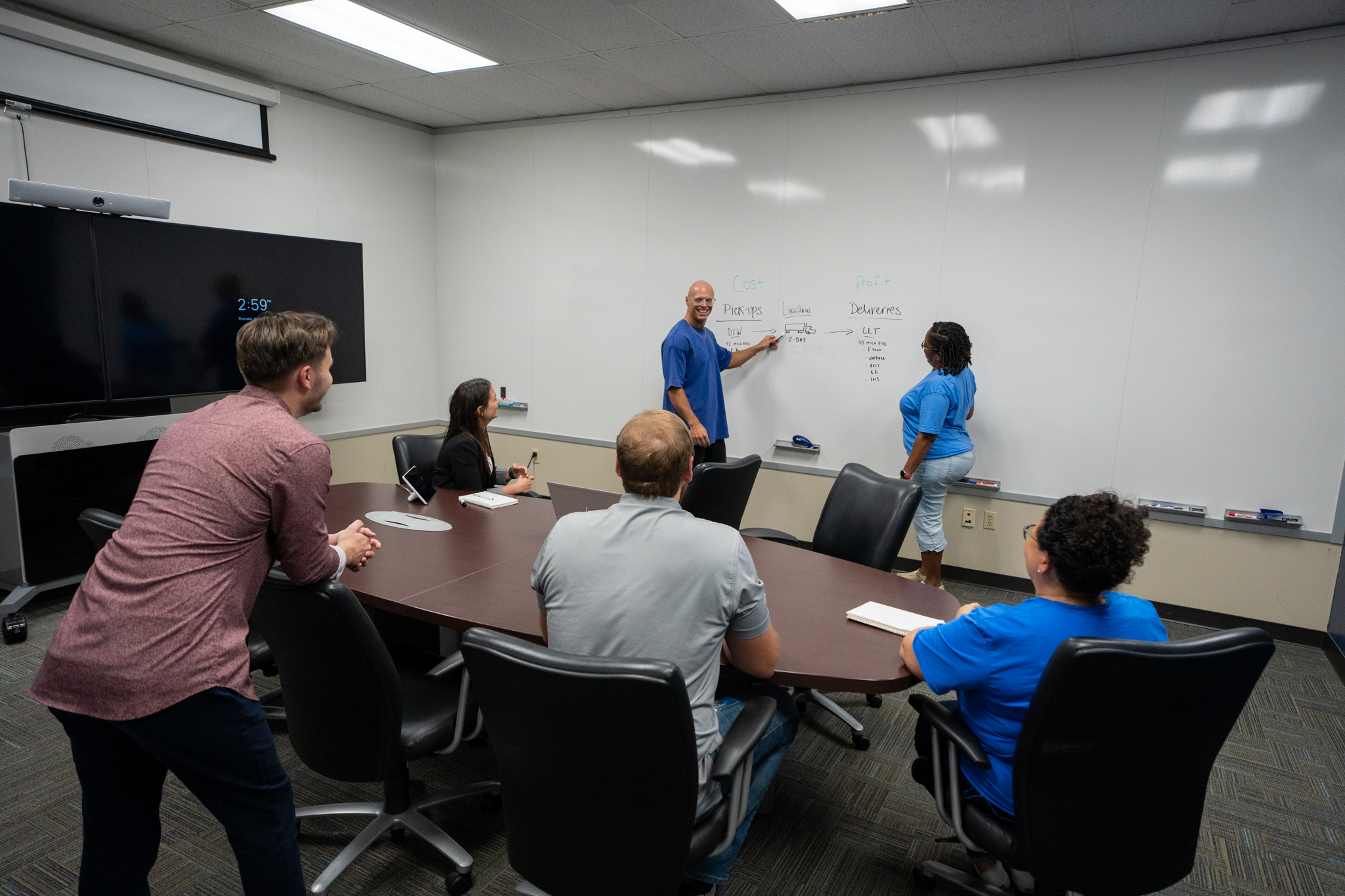
Navigating Market Shifts Through Adaptive Supply Chain Partnerships
As we move toward 2026, supply chains continue to be reshaped by structural change. Nearshoring and reshoring initiatives are accelerating. International volumes remain tight. Domestic markets continue to face pressure. At the same time, contract logistics has emerged as a critical growth engine.
“Our role is to sit down with partners and stakeholders and make sure we’re prepared to support where their business is going,” Hiram says.
Adaptive supply chains are built through partnership. By engaging early with clients, we can align capacity, pricing, and network design to support both near-term execution and long-term resilience. Gartner research reinforces that organizations with collaborative, adaptive supply networks outperform peers on cost control and service reliability.
These partnerships allow us to respond with confidence as market conditions shift, rather than react after disruption has already occurred.
Technology and AI Powering Collaborative Logistics Solutions
Technology continues to reshape logistics, but its greatest impact comes when it strengthens human partnerships. Our investments in systems and artificial intelligence focus on reducing friction, improving visibility, and enabling better decision-making across the supply chain.
“We don’t want to eliminate jobs,” says Hiram Hartnett, Executive Vice President of Sales at Pegasus Logistics Group. “We want to eliminate redundancies and give people an opportunity to do something more fulfilling.”
Used intentionally, technology enables more collaborative logistics solutions by helping our teams and partners:
- Reduce manual and repetitive administrative work across invoicing and documentation
- Improve visibility across global supply chains to support faster, more informed decisions
Strengthen data-driven forecasting and network optimization - Create space for teams to focus on strategic planning and deeper client collaboration
From automating invoice processing to supporting partners navigating the AI revolution, we view technology as an enabler of better outcomes, not a replacement for relationships. According to the World Economic Forum, organizations that pair advanced technologies with cross-functional collaboration achieve stronger customer satisfaction and operational performance.

The Client Experience as the North Star for Logistics Partnerships
As we grow and evolve, our focus remains grounded in one principle. The client experience is our North Star. Expansion, new partnerships, new technology, and new talent all introduce change, but they also raise expectations.
“It’s kind of irrelevant how you define on-time performance,” Hiram says. “What matters is how your customer perceives your service provider. Ultimately, we’re the face of our client.”
Traditional performance metrics are essential, but they are table stakes. What matters most is understanding how logistics performance impacts our clients’ customers. “Instead of just giving stats, we want to understand what the real statistics are that matter,” Hiram adds.
To remain relevant in a dynamic global logistics environment, we maintain a strategic outlook and a learner mindset. “We don’t know what we don’t know,” Hiram says. “So we make sure we’re consistently driving the right strategies to stay relevant in the future of logistics.”
The future of global logistics will be built by partners who plan, adapt, and grow together. Connect with Pegasus Logistics Group to explore how collaborative logistics partnerships can strengthen your global supply chain strategy in 2026 and beyond.