

In global trade today, the rules can change overnight, and in many cases, they do. Tariffs are announced at midnight, regulatory guidance shifts before a webinar concludes, and shipments are seized because documentation does not fully account for a component’s origin.
For supply chain, procurement, and operations leaders navigating this environment, resilience often comes down to a single question: do you have the right partner in your corner?
We spoke with Meloney Norris, Managing Director of Customs for PLG Customs Brokers, the customs brokerage division of Pegasus Logistics Group, to better understand what is happening.
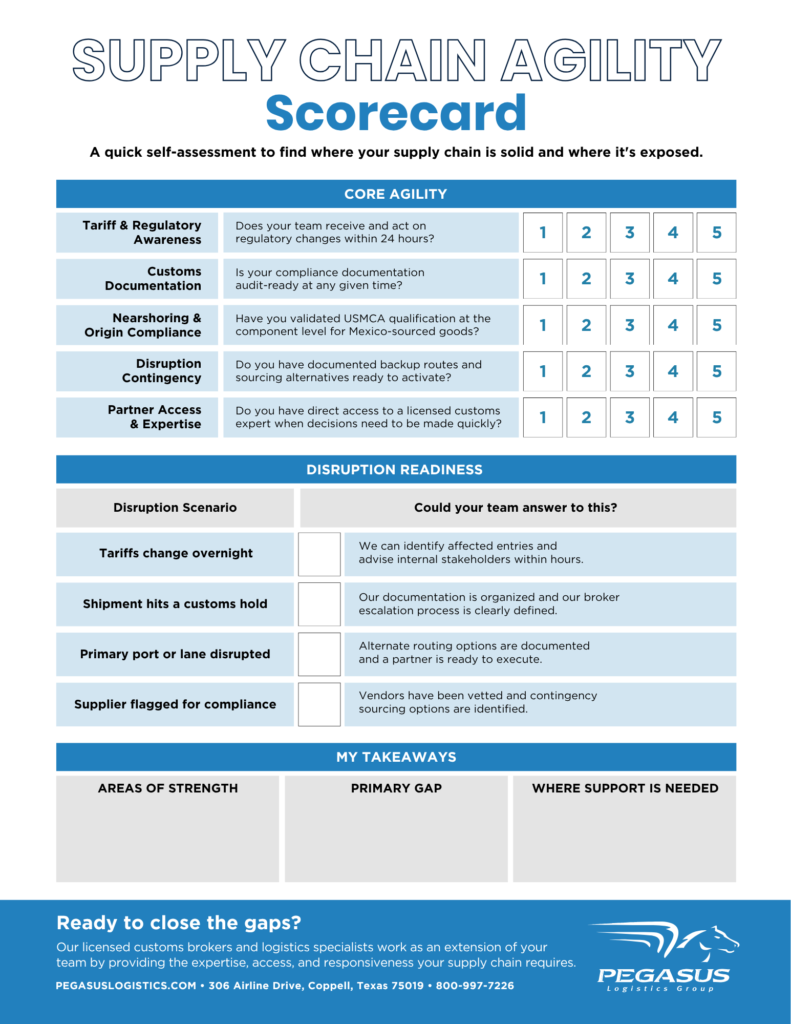
As you read, make sure to download our Supply Chain Agility Scorecard to assess your readiness across compliance, sourcing strategy, and disruption planning.
The Global Trade Environment Right Now
The current state of global trade is defined by constant change, where tariffs, regulatory updates, geopolitical disruption, and compliance requirements are all evolving at the same time and often without much notice.
This pace of disruption is not anecdotal. According to Supply Chains Magazine, the Geopolitical Risk with Trade index increased by about 30 percent between 2020 and 2024, while the Global Supply Chain Pressure Index has nearly tripled, pointing to sustained volatility across global supply chains.
“It changes sometimes daily. I’ve attended webinars where they start out the conversation with, ‘This is what we know as of now.’ And by the end of the webinar, somebody comes back and says, ‘We have an update.’ That’s the reality of what it is right now.”
— Meloney Norris, Managing Director of Customs, PLG Customs Brokers
At the same time, importers are navigating requirements from agencies such as the FDA, DOT, and EPA, as well as forced labor regulations, free trade agreement documentation, and record-keeping obligations that can extend back five years. When compliance visibility breaks down, shipments may be held, goods may be seized, and delivery commitments may be missed, directly impacting customers and cost structures.

Nearshoring and USMCA Compliance Considerations
As companies move production closer to the United States, particularly into Mexico, many are encountering an additional layer of supply chain compliance complexity that requires careful planning and documentation.
USMCA offers duty advantages, but qualification depends on the origin of each component within the finished product. A “Made in Mexico” label on its own does not determine eligibility, since every input must meet specific requirements and be supported with documentation.
“A lot of times, those goods manufactured in Mexico may be made from components sourced from China or India. There are certain regulatory requirements and percentages that have to be met… and they have to be able to prove it to customs with the bill of materials.”
— Meloney Norris
For organizations evaluating nearshoring strategies, the priority is to understand the origin of each component before goods move. Establishing documentation and validation early helps prevent delays, holds, and unexpected costs at entry.

Supply Chain Compliance Risks Importers Often Miss
One of the biggest challenges in global supply chains is the compliance knowledge gap. This is not because importers are careless, but because the rules are complex and constantly changing.
Many companies do not realize how broad these requirements are. For example, the FDA regulates more than just food and medicine. Products like sunglasses, gloves, bandages, tweezers, and toothbrushes can all fall under medical device rules, each with specific documentation requirements.
Tariffs can also be difficult to apply correctly. Under Section 232, importers of certain steel and aluminum products are responsible for tariffs based only on the value of the metal component, not the full product. Getting this right requires accurate cost breakdowns and clear documentation.
To stay compliant, importers should focus on a few key actions to help reduce the risk of delays, audits, and penalties:
- Confirm product classification and country of origin before shipping
- Validate supplier documentation and bills of materials
- Work with a licensed customs broker early in the process
- Seek guidance when regulations are unclear
- Keep complete records for at least five years
Liking this article? Read our blog on How to Reduce International Freight Costs: Strategies for Smarter Global Shipping Budgets.
Supply Chain Risk Management and Global Disruption Planning
Supply chain resilience depends on the ability to continue operating when conditions shift, even when those changes are sudden or outside of an organization’s control.
“There are certain places ships aren’t moving. Certain places you can’t fly over that airspace right now. You may have planned to do business with this particular partner, and now you can’t. To be ready, you need to have a plan B, a plan C.”
— Meloney Norris
This level of preparation includes identifying alternate sourcing regions, building flexibility into transportation routes, understanding second and third tier suppliers, and conducting supplier vetting from a compliance standpoint.
Customs authorities now use advanced tools to identify forced labor risks and high risk entities across global supply chains, which makes proactive oversight essential.
For organizations looking to benchmark their supply chain readiness across these areas, having a structured way to assess gaps can help prioritize where to act next
Download Your Supply Chain Agility Scorecard
Assess your readiness across five key dimensions, including tariff response, compliance documentation, nearshoring complexity, disruption planning, and partner access.
Building an Agile Supply Chain
In an environment where regulations shift quickly, having the right partner in place can make the difference between reacting and staying ahead.
Building an agile supply chain requires visibility, strong compliance practices, and the ability to adapt as conditions change. It also requires working with a team that understands how operational and regulatory challenges intersect across the supply chain.
“We’re able to be accessible… to answer their questions, to jump on a quick call when the tariffs change at midnight.”
— Meloney Norris
Pegasus Logistics Group supports this approach by helping clients navigate complexity with clarity, so their supply chains can continue to move as conditions evolve.
If you are looking to better understand your current position, contact us! Our team can help you assess your supply chain and identify where to strengthen it.